Product Description
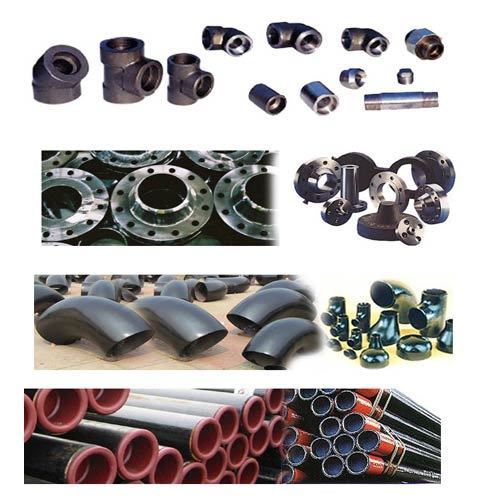
Being a quality-centric organization, we are engaged in manufacturing and supplying Alloy Steel Pipe. Demanded for various industrial applications, the offered pipe is manufactured with the help of modern tools and machines by our team of experts. To meet the exact demands, we offer this pipe in different lengths and thicknesses at market leading prices. Our offered Alloy Steel Pipe is manufactured as per the industry set norms.
Features:
-
Easy installation
-
Rust resistance
-
Durability
Versatile Connection and End TypesOur alloy steel pipes and fittings support multiple connection options including butt weld, socket weld, and threaded ends, as well as various finishing ends like plain, beveled, or threaded. These configurations ensure compatibility with a wide range of systems and installation requirements, accommodating unique pipeline or plant setups effectively.
Comprehensive Standards and GradesManufactured to rigorous international standards such as ASTM, ASME, DIN, and EN, our products are trusted for critical applications. With grades like ASTM A335 P11, P22, P5, P9, and ASTM A234 WP11/WP22, users are assured of mechanical strength, heat resistance, and safe operation in demanding industrial settings.
Reliable Performance and Corrosion ProtectionUtilizing advanced techniques like hot rolling, cold drawing, and forging, these alloy steel pipes and fittings boast high corrosion resistance. Surface treatments such as galvanizing, polishing, painting, or annealing protect against aggressive environments and ensure longevity, minimizing maintenance needs in pipelines and industrial infrastructure.
FAQs of ALLOY STEEL PIPE AND PIPE FITTINGS:
Q: How are alloy steel pipes and fittings typically used in industrial applications?
A: Alloy steel pipes and fittings are widely used in pipelines, power generation, oil & gas, petrochemical facilities, and construction projects for transporting fluids and gases. They are favored for their high strength, corrosion resistance, and ability to withstand high pressures and temperatures.
Q: What is the difference between butt weld, socket weld, and threaded connections?
A: Butt weld connections offer a continuous metal structure for maximum strength, commonly used in high-pressure pipelines. Socket welds involve inserting a pipe into a recessed fitting, providing excellent structural stability. Threaded connections are suitable for lower-pressure systems, allowing for easy assembly and disassembly.
Q: When should I choose galvanized or annealed surface treatment for alloy steel pipes?
A: Galvanized pipes are ideal for corrosion-prone environments, as the zinc coating protects against rust. Annealed pipes, on the other hand, are heat-treated to enhance ductility and toughness, making them suitable for applications requiring formability or frequent temperature changes.
Q: What pressure ratings are available for these alloy steel pipes and how do I select the appropriate one?
A: Available pressure ratings include Sch 20, Sch 40, Sch 80, Sch 160, and XXS. The choice depends on your applications pressure requirementshigher schedules (like Sch 160 or XXS) are used for high-pressure pipelines, while lower schedules suit moderate pressures or non-critical operations.
Q: Where are alloy steel pipe fittings typically sourced and supplied in India?
A: These fittings are supplied by importers, manufacturers, suppliers, and traders across India, ensuring nationwide availability for industrial, plumbing, construction, and chemical applications.
Q: What is the manufacturing process for these alloy steel pipes and fittings?
A: Techniques include hot rolling, cold drawing, and forging, followed by processes like galvanizing, polishing, painting, or annealing. Each step enhances the pipes mechanical properties and surface protection, ensuring reliability in demanding use-cases.
Q: What are the benefits of premium packing methods for alloy steel pipes and fittings?
A: Premium packingusing bundles, wooden boxes, and plastic caps on endsensures products remain protected from physical damage and contamination during transit, guaranteeing they arrive in optimal condition.
 07313726649

 sdm2099@gmail.com







 Send Inquiry